Answers
Ask questions and get answers from experienced industry professionals
Search: 3个交易日内有涨停板 非创业板 非科创板 今天非涨停

Dean D Sutherland asked:

Jim Myers of AASI Home Improvement Systems PRO answered:
You must have paid without inspecting the work. Building code requires a weather barrier under the siding and that it be taped at openings and all seams. Was there a permit obtained to do the work? If not, did your locality require one. If they did, report the contractor to the inspection department as having not pulled a permit and gotten the right inspections. They may be able to help you and it oculd be a license violation in your state. Although most will refuse if a permit was not obtained and the proper inspections performed. Maybe they will go after the contractor and have them make it right. Have you checked your ceiling insulation? Heat rises and if the attic is not properly insulated(This is where 2/3 of the heat escapes from a house. and the soffits(overhang)need to be vented. Heat will escape through the roof. How about your windows. Caulking around the j- channels where it meets the frame may stop some air and water infiltration.Do this with a clear caulking made for that purposed. A lot of heat escapes through windows if they are not properly sealed. You may be able to put some plastic film over the windows and inside casings like 3-M. This may also help you with heat loss. There are foam inserts that you could put in the electrical outlets by removing the cover screw ,,pulling the cover, putting them in place and then puttng the screw back in. Maybe the walls should have been insulated while you had the siding off. There are many things you havent't told us but these are ideas that may help your situation. It sounds like you do not have a foundation with blocks. But they are also a souce of heat loss. If you do, you could insulate the rim joists with a high density foam sheet and cut them to fit. and then use caulk or spray foam to seal around the edges. Hope this helps you.

GuildQuality Team asked:

Mary Nolan answered:
When you are looking for a professional contractor to successfully bring your home remodeling project to life, you need to make sure you do your homework.
Below are 6 things to consider before hiring a contractor:
1.What is their track record? How long have they been working in the area?
Check out the home remodeling companies you are considering on the Better Business Bureau’s website as well as other sites like Angie’s List. Read testimonials on review websites and look over company websites for portfolios and comments from past clients.
2.What are their credentials? Are they licensed? Bonded? Insured?
States set their own requirements about licenses, but most states have an agency that homeowners can contact to confirm a contractor’s license and credentials. Ask for proof of bonding to make sure your contractor is current on his/her credentials. Insurance puts the liability on the contractor if something goes wrong during the project. Not all insurance is created equal, make sure to ask for a copy of their insurance certificate to verify they have General Liability, Workers’ Compensation, and Auto coverages.
3.Do they have references? Will they provide you with a past client list?
Use a past client list to talk with the people your client has worked with before. Ask them if the contractor delivered what was promised on time and at the agreed upon budget. Also ask about how easy or difficult it was to communicate with the contractor.
4.How will they communicate with you? How do you reach them after hours?
Make sure you agree on how you will communicate with your contractor and if you need weekly in person meetings to get your questions answered.
5.Will they be getting all the required building permits for the project?
While the homeowner pays the cost of the building permits, the contractor should be the one responsible for obtaining the permits.
6.How will the payment schedule be arranged?
For replacement work never pay the entire amount before the project starts. Payment schedules vary from company to company, but there is usually a deposit and payment installments based on certain stages of completion.
Just as you are asking questions about your contractor, your contractor will be asking questions about you and your home remodeling project. It is important that you are aware of the questions your contractor should NOT be asking you.
Sometimes a contractor is trying to find out information about a project, but he/she may phrase questions in a way that makes the homeowner feel uncomfortable.
Listed below are some questions your contractor should NOT ask you:
1.Are you widowed?
2.Do you have money in your savings account?
3.How much money do you make?
4.Will you be alone when I arrive?
5.What is your credit score?
6.May I see your other bids before I present mine?
In Angie Hicks’s article, “3 Questions Your Contractor Shouldn’t Ask,” from Angie’s List she explains how home improvement contractors can be more tactful when they request information from clients.
Check out the article here: https://www.angieslist.com/articles/3-questions-your-contractor-shouldnt-ask.htm

Connie Todarello asked:

Abe Degnan of Degnan Design-Build-Remodel of Madison PRO answered:
In my personal home which has high quality windows, we also suffered condensation. We generate moisture by breathing, cooking, and bathing. If you have casement windows with screens on the inside, you might be surprised just how much those screens prevent convection airflow and keep cooler air closer to the window glass. We solved the problem in our home using a combination of 3 actions.
1) We remove our window screens every winter.
2) We open our window shades all the way every morning and leave them open all day long.
3) We have timers on our bathroom fans and run them for about 4 hours per day in addition to the 10 or 20 minutes of bathing time.
4) Bonus: We always run our kitchen vent fan when we are cooking to remove moisture (and odors) from the house.
I hope that helps. In the end, it's all physics. It's about the dew point, which is the surface temperature at which the relative humidity condenses. It can happen with cheap or expensive windows.
By the way: If there is air leakage around the window, this is going to exacerbate the problem. So doing a call-back to the installer or a 3rd party energy-rating company would help if the other solutions don't work.

Francisco Trevino asked:

Tim Brown JR of RGS Exteriors PRO answered:
Most states do have a 3 day right of recison. This allows a customer to cancel a contract without any penalties and or fees within 3 business days of contract. However in most cases that rule does not apply and the law does not apply if you have invited the contractor over and or if you have gone to their place of business. This law was put in place for the high pressure door knockers.
Again if you set up an apointment with a contractor and invited them to your home the 3 day does not apply.
That said if there is a real good reason, car accident, unforseen expsences etc. most contractors will allow you out of a contract even if after 3 days.
Lastly please keep in mind usually 30% of the cost of the job is actually before the job has started, marketing, commisions, adminstration etc. etc.
I hope this helps.
Tim Brown RGS Exteriors and Contruction
801-280-3110
Francisco Trevino asked:

Tom Schiebout of Tomco Company PRO answered:
In MN. we have the same 3 day right to rescind. This is standardized form (written legibally) in type 10 bold letter type. My understanding, it is required to be given to the client if contract you sign is in the homeowners residense. Not if the contract is signed in the our company's office. We give it to our clients either way. The 1st day starts the day after you sign and is counted daily except for weekends and holidays.
The real issue is... if you are having 2nd thoughts about being in contract with a particular contractor. I am thinking that I as a contractor, I would certainly need to know the issues, even if after "3 days right to rescind" has passed. I typically don't order product for any project until the time period has passed. If you want to get out of your contractoral obligations, there should not be any financial obligations from your part if contract is legally rescinded according to the form and in an appropriate time period. If after there may be some fees as your contractor may have spent time to proceed with your material and scheduling process for your project.
Hope this helps.

Bryan Jones of GuildQuality PRO asked:

Joe Kennedy of Kennedy Windows & Doors, Inc. PRO answered:
Bryan-
If you mean that the walls are 2 x 4 and framed already below the screens and you just want to replace the screens with windows, then you have a few options depending on your budget.
The most expensive we've done involved replacing the screens with Pella Designer Series casements and picture windows with miniblinds inside the glass. A picture window with blinds can be made up to 59 inches wide, and a casement that will crank open has a maximum frame width of 35 inches. That customer was very pleased with the result, and he had budgeted extra for the premium windows. Figure $1200 to $1500 per opening for that option.
The least expensive we've done involved Pella Impervia fiberglass sliding windows and we installed a couple of 6 foot wide 2-panel units and a couple of 9 foot wide 3-panel units. They are strong, look like painted wood not vinyl, are energy-efficient and offer a lot of ventilation. Unlike the casement windows that crank out and are somtimes problematic with backyards or walkways nearby, sliders can be opened with no projection. Figure about half as much to do that.
Of course you can use single or double-hung windows but it would take 2 or 3 to fill the opening that a single slider can, and the slider will give you more visible glass and the same ventiliation. The customer that used the sliders lived across from the beach, and he actually removes the venting panel from each of his sliders for the summer and puts it back in for the winter. However he had a pretty wide overhang to keep out the summer rains.
As far as the A frame you can of course install triangular shaped windows to let light in and keep the cold out. Consider something with a stronger Low-E coating in the glass to keep out the sun's heat.
All of the above of course might require beefing up the framing below and between the windows to accept the extra weight over the screens.
Good luck with your project!
Joe

John Ford asked:

Ken Lindner of Red Carpet Remodeling PRO answered:
John Ford, There are an abundance of energy efficiency upgrades you can do to your 2-story home. A question to your question - do you have a small or a larger budget? Small budget - 2 options: Attic Insulation or A Foil Energy Barrier, one example is Green Energy Barrier. Blown-In Attic Insulation is inexpensive and can help with an additional R-value of 18-60 in your attic. A Foil Energy Barrier - can be placed along the rafters or floor boards and is a foil used by NASA that greatly assists with energy efficiency. Larger budget - 3 solid options: Solar panels, Replacement Windows with Krypton gas, or Insulated Siding, an insulation with a system R-value of a 4.2 that contours to your siding panel. Best, Ken
John Ford asked:

Rob Owens of VTS Homes, Inc. PRO answered:
The materials are just 30% of the cost. They are labor intensive and if you are fairly handy you can save a bundle of money doing it yourself. However, this is not a task for the average DYI. If you hire someone to supply and install the system you can plan on spending $3,000 and up depending on the size of your closet.
John Ford asked:

Jayme Potter of Metroplex Roof & Fence PRO answered:
Supplies needed:
hopper gun and compressor (available for rental at home-center stores), paint tray, paint suit and glasses, stepladder , putty knife, paint mixer, paint roller, masking tape, drop cloths, ceiling texture, primer sealer, spackle
Here are the steps you need to take to get the job done:
1. Fill any dents or imperfections in the ceiling with spackle, and then apply a coat of primer with a roller. Allow the primer to dry at least four hours.
2. While it's drying, mask off the walls and floor with masking tape and tarps, plastic sheets or drop cloths.
3. Wearing proper protective clothing and goggles, pour some texture mix into a large bucket and mix according to directions. Use a paint-mixer attachment to achieve a nice blend. The mixture is ready when it's the consistency of thick porridge.
4. Fill the hopper with texture mixture and fire up the compressor. Practice spraying on an old board or a large piece of cardboard to get the feel of the machine.
5. Lightly spray the mixture onto the ceiling, and keep moving to avoid oversaturating any area. Use multiple light coats and allow the texture time to dry between coats. If you spray the texture on too thickly, it will drip off the ceiling.
John Ford asked:

Eric Consuegra answered:

Bekah Taylor asked:

Gregg Cantor of Murray Lampert Design, Build, Remodel PRO answered:
I am assuming your home is ducted and has a forced air system. If you you only have 1 furnace and 1 condenser, it my be more energy effecient to expend to two units. I recommend Lennox. You can also look at installing spilt units like these made by Fujitsu:
http://www.fujitsugeneral.com/products.htm
These are designed so that you can cool a room/rooms individually. I suggest calling a few licensed HVAC contractors and get 3 quotes.
Dan Vorona asked:

Michelle Slowe answered:
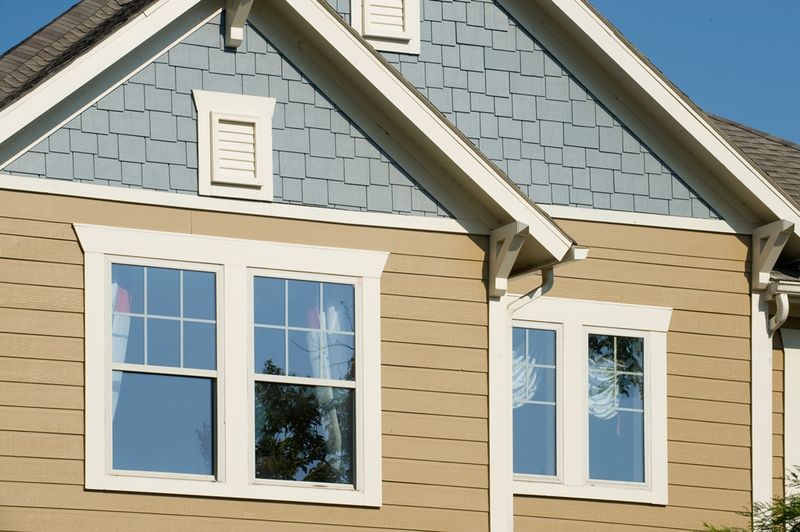
We at NEWPRO have a alternate view from our industry colleague, Mr. Damora. Since the greatest concern you voiced was the lack of insulation in your extension, we recommend Vinyl Composite Siding, also know as Insulated Vinyl Siding.
Hardie Plank is a cement board; it's composition is sand and water. It is heavy on the wall and provides no insulation value. Formed to resemble wood, it fails to provide a deep, rich grain and does not come close to the look of wood. It is highly susceptible to mold and mildew. Hardie Plank has many seams and the seams must be sealed or water can infiltrate behind the siding. It can crack and if it does, you must tear the whole wall down in order to replace just one plank. It also is not maintenance free and requires painting every 10 years.
Insulated Vinyl Siding solves all of the aforementioned problems. It has high R-value, some up to 5.3, and has the potential to yield an 80% return on investment due to the increased energy efficiency and lower energy bills. You can learn more about this from the highly respected Remodeling Magazine's Cost to Value 2014 Report.
Additional benefits of Insulated Vinyl Siding include:
- Having a deep, rich grain and a real wood look
- There are less seams, which are water-tight
- It rarely ever needs painting
- It is mold and mildew resistant
- There are far less installation problems and less likely to need repairs.
- If repairs are needed, its easy to replace a single panel.
I hope this information is helpful. Being located in Massachusetts, we didn't get nearly as rough of a winter as the Chicago area, but we can certainly understand why you put insulation so high on your Siding Needs List!
All the best,
Michelle Slowe
NEWPRO

John Ford asked:

Hdr Remodeling of HDR Remodeling PRO answered:
Before you do anything new...look at what is already there.
1. Do the existing windows allow drafts? Upgrade existing windows first before considering new windows. I don't think the payback is that great over existing windows that are properly maintained.
2. Is the header serviced annually? Change the filter monthly (there are so cheap), check all the ducts for breaks and tape them up. Walk around the house when the heater(s) are on and check the temperatur in each room. When you have done your homework then have a profeswsional come in.
3. Seal around the ceiling can lights on the second floor that are allowing heater air into the attic.
4. Replace the seal around all your exterior doors. This is really the case on the door from the garage to the house.
Start there \Philp Anderson HDR Remodeling Berkeley CA
Dan Vorona asked:

Michael Damora of K & B Home Remodelers, LLC PRO answered:
Without question you should invest your money in Fiber Cement Siding for the following reasons:
1. Authentic and more tranditional appearance.
2. Better fire rating.
3. Does not fade like vinyl.
4. Higher Return on Investment.
5. The ability to paint your house should you choose, down the road.
6. Will not warp, buckle or move on the walls.
7. The trim finshes that can be achieved with Fiber Cement are not possible with vinyl.
How would you like to have been the last person on your block to have bought Aluminum Siding 30 years ago? That is the reality of today's exterior cladding market. The vinyl industry is scambling but have yet to come up with a viable alternative to Fiber Cement. There are some new composites that are starting to make inroads but they are still too costly and are in limitied profiles.
Be sure to choose a Perfered James Hardie Contractor so you know all the best practices will be followed in accourdace with the manufactuere's specifications.
Unlike vinyl, Hardie Board needs a skilled craftsman to insure a propoer and long lasting installation.
Michael Damora
K & B Home Remodelers

Popular questions
Popular topics
Featured Guildmembers
AASI Home Improvement Systems

Degnan Design-Build-Remodel of Madison


RGS Exteriors

Tomco Company
Kennedy Windows & Doors, Inc.
Red Carpet Remodeling

VTS Homes, Inc.
Metroplex Roof & Fence

Murray Lampert Design, Build, Remodel

HDR Remodeling

K & B Home Remodelers, LLC