
Bryan Jones asked:
Mar 24, 2017


Energy efficent windows are a good investment.

I'm from Wisconsin and we have a program called Focus on Energy which implements the ENERGY STAR program for improving energy efficiency of older homes. I'm not sure what you have in your region, but I specifically recommend starting with an expert company that can do a blower door test on your home and use an infrared camera to detect where you have air leakage and heat loss.
The number one cause of heat loss is air leakage. So insulation alone will not solve that problem. Leaky ring joists in the basement where the walls, floor, and foundation meet are one culprit... there is generally lots of inward air leakage here. And in the attic, there are a bunch of sources of air leakage, where warm air wants to rise and escape up and out. (So by the way, ice dams on the roof are not solved by adding more attic ventilation; rather they are solved by first doing air sealing, and second verifying or improving insulation.)
If you intend to DIY this, you can still hire a consultant to do the pre-testing and post-testing, and you might even be eligible for some financial incentives. If you hire a professional company to do it, the cost can be reduced by those incentives.
If you won't hire a pro, then here's a few rules of thumb:
1) Remove fiberglass insulation from ring joists, and either use spray foam or rigid foam to insuate the ring joist, use spray foam to seal the rigid foam in place, minimum 2" thick and you can always fit the fiberglass insulation back in place again when complete.
2) Spray foam over top of wall plates in the attic.
3) Put a gasked on your attic hatch. If you have an attic ladder, buy a specific air sealing enclosure to prevent air leakage through it.
4) Find out if your recessed can lights are IC (Insulation Contact) rated or not. They will be labeled if they are. Build a sealed box around them allowing air space for heat build-up, and consider converting to LED lights so that there is less heat generated. If not IC rated, use cault to seal them to the drywall or plaster, and to close up the holes in the lights themselves.
That's a primer on things... there is more to be done, but these can help!


Set it where you are most comfortable as that is why you have it. A good idea is to update the thermostat to a programmable version that will run the A/C mostly when you are home and according to your schedule as well as at the desire temperatures. It isn't necessarily recommended to shut off the A/C on warmer days when you are not there as it will have to struggle to catch up when you turn it back on. This would be due to the warmer air in the home and the storage of heat in the walls, ceilings, floors etc in your home.


You can also look into programmable thermostats!


Search for a door protection kick plate. This will cover current damage and protect for any future...

this is very common in new homes. I would work with the builder first. That is the easiest way to correct the problem. They are in the buiness of building home and need good referrals I would try the builder again and you would be surprised at the outcome with a softer approach.
Philip Anderson
Berkeley Ca

Spray Foam. Much better insulator and fills any gaps that might otherwise be missed.
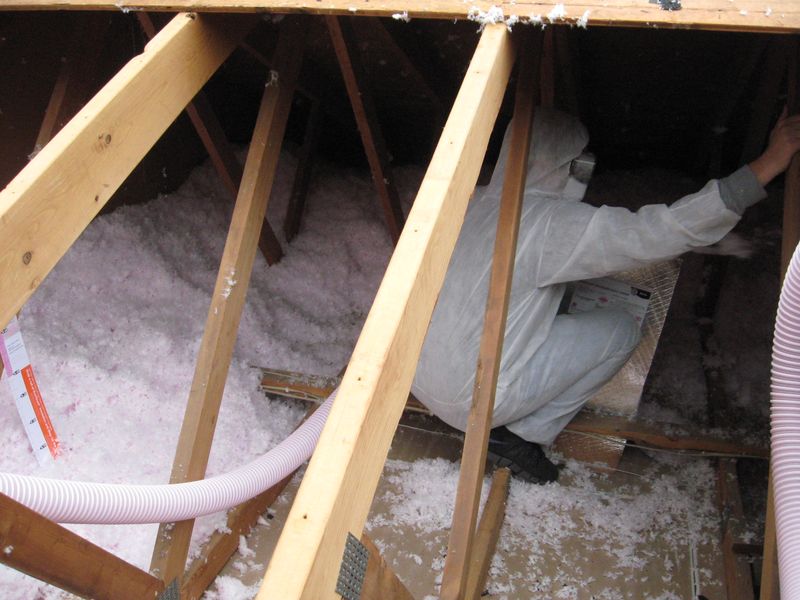
Check seals on doors & windows. Replace single pane windows with newer products. Check the attic for insulation. Loose fill, blown in insulation is the best. Make sure to seal any spots where air is escaping INTO the attic first. Also make sure your attic has both adequate intake AND exhaust ventilation. Make sure not to clog the airflow from the soffit area and the attic space by using Baffles as seen in the picture. Check out YouTube for other great suggestions.


Insulation may not be the only thing you need. It is also important to have air flow through the attic. this is best accomplished by eave or soffit venting and ridgevent.
According to most building codes, you need one square foot of vent area for each 150 square feet of attic floor space. The minimum is one square foot for every 300 square feet of attic floor space if there is a vapor retarder or the space is balanced between the ridge and intake vents. A balanced ventilation system means about 50 percent of the required ventilating area should be provided by exhaust vents in the upper portion of your attic with the remaining 50 percent provided by intake vents.

Hey John,
This is a common problem with many homeowners with rooms above the garage. There really isn't a solution to completely remedy your problem. Here are a few suggestions to help alleviate the harshness of the extreme temperature changes.
1. Check the insulation above the room and make sure its at least R-60.
2. Insulate attic kneewalls if you have some with R-19 and then with foam board.
3. Air seal any holes from wires, pipes, vents or ducts to that room.
4. Insulated Garage doors help a lot.
These are some things you can do yourself that will help make your room more comfortable. It's a good idea to hire a professional to perform a whole house energy audit and complete HVAC system check.
We have had a lot of positive results with these options and I hope they help you too.
All the best,
Charlie
Aladdin Insulation and Home Improvements

Hey Alex,
?I would say that close cell spray foam insulation is the way to go if your budget allows for it. Although it's much more expensive than batt insulation, the long term savings on your energy bills will be far greater.? Hope this helps!
Cheers,
Eric Consuegra, AROCON Roofing and Construction, LLC

I would encourage you to read up on SPF and if you do go that route, make sure you get a great and insured installer. SPF does have additional benefit from and air sealing standpoint but beyond the airtightness improvements, does not (in the case of OC SPF) have any greater R-Value than traditional batting assuming that both are in an static air environment. Best thing you can do from a real high performance wall assembly is to thermally uncouple the exterior wall from the framing. This will net you a much higher performance assembly than SPF alone but should be done by someone that is familiar with this approach and applications.
SPF is great but I prefer it to be used as an air sealant first and foremost.
Educate yourself on the pros and cons before you engage in an insulation schedule.
Eric Novotny

I think you really need to see both on a home and decide what looks better to you. Vinyl will be cheaper and is a more modular system and less prone to leakage and installation errors.